
The Mark
A Novel
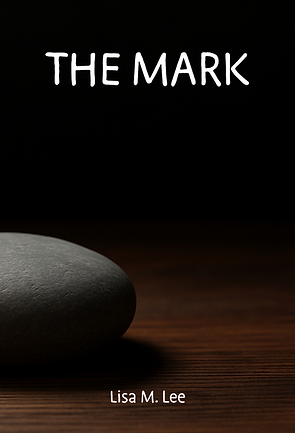
She left him a stone, a map, and one word: Remember.
He had spent his life learning to forget.
Rey Samson is an actuary—a man who has made a career of reducing uncertainty to numbers, of making the chaotic world orderly and predictable. He lives in a Chicago apartment of white walls and black furniture, a monument to the disappearance he perfected as a child: the performance of the good son, the successful professional, the man who asks nothing, reveals nothing, demands nothing.
When his mother dies, she leaves him a locked box she has kept for thirty-three years. Inside: a river stone worn smooth by years of holding, a photograph of a woman he has never seen, a hand-drawn map of a Cornish fishing village, and a single word in her precise hand: Remember.
Rey does not know what he is supposed to remember. He does not know what his mother hid for three decades. He does not know why she waited until she was gone to give him the key. But the stone calls to something in him he thought he had buried long ago—the eleven-year-old boy who stood at the top of the stairs and watched his father strike his mother, who learned that safety lay in silence, who has been disappearing ever since.
He travels to Porthleven, a village on the Cornish coast, carrying his mother's stone and her secret. There he finds Sara Carpenter, an old woman who knew his mother before she married, who speaks of something called the Seam—the place between worlds, the space where truth lives, the feeling you get when you stop performing and simply are. And there he finds Harlan, a man who repairs boats in a derelict yard at the edge of the harbor, a man who has spent fourteen years learning to be present, who refuses to save anyone, who offers nothing but the silence that holds.
"I don't know if I can help you," Harlan says. "But I can listen."
The Mark is a novel about the architecture of disappearance—the cages we build around ourselves, the performances we perfect, the silences we learn before we can speak. It is about a mother who left her son a map to a place he had forgotten, and a man who spent fourteen years learning that the only thing worth doing was the thing in front of you, done with attention, done without hope of reward, done because it was the thing that needed to be done. It is about the long work of unbecoming, the slow practice of presence, and the moment—small, unheralded, easily missed—when a man who has spent his life running finally stops.
In prose that moves with the patience of the tides, Lisa M. Lee has crafted a story about the people who hold space for us when we cannot hold it for ourselves. About the wondering souls who arrive without knowing why. About the ones who stand where the light is, asking nothing in return. About the choice—made again and again, in the thousand small moments of a life—to be present, to stop running, to be here.
The Mark is a novel for anyone who has ever learned to disappear. For the ones who are still learning to be seen. For the ones who are only now beginning to understand that they were never the problem, that they have always been allowed to exist, that the only way out is through—and that through is a place we can reach, together, in silence, in presence, in the boatyard at the edge of the harbor where the cormorant sits on its rock and the tide comes in and the work continues, always, the work of becoming.
"The Seam is not a place. It is the choice to be present. It is the choice to stop running. It is the choice to be here, now, without armor."